The Resurgence of Pixel Art Black and White Retro Tech in Modern Branding
In an era dominated by hyper-realistic 3D renders and seamless gradients, a distinct visual counter-movement is gaining significant traction among forward-thinking creatives and brands. This movement is defined by the aesthetic purity of Pixel Art Black and White Retro Tech. It is not merely a nostalgic nod to the early days of computing; it is a strategic design choice that communicates authenticity, clarity, and a unique digital heritage. For professionals, entrepreneurs, and marketers looking to cut through the visual noise of the modern web, this high-contrast style offers a compelling narrative tool.
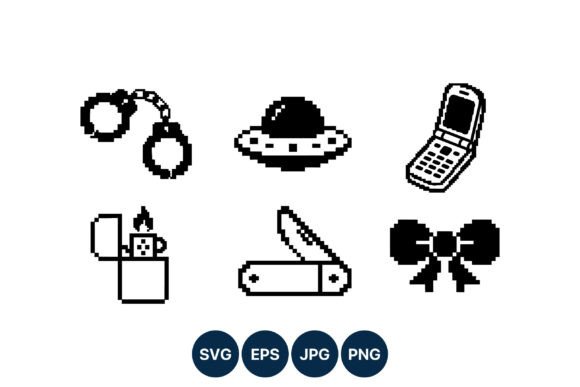
This article explores the mechanics, market relevance, and practical application of this specific aesthetic, focusing on a curated collection of icons including handcuffs, a UFO, a flip phone, a lighter with flame, a pocket knife, and a decorative bow. By examining these elements within a grid layout context, we can understand how retro technology aesthetics are reshaping contemporary visual workflows.
Defining the Aesthetic: More Than Just Nostalgia
Pixel Art Black and White Retro Tech is characterized by its deliberate limitation of resolution and color palette. Unlike standard raster graphics that rely on anti-aliasing to smooth edges, this style embraces the "jagged" look of individual pixels as a primary design feature. When stripped down to a monochromatic binary—pure black against pure white—the result is an image of striking boldness and immediate legibility.
The appeal lies in the reductionism. In a complex digital landscape, simplicity is a luxury. This style forces the designer to distill an object to its absolute essential form. Whether it is the mechanical complexity of a pocket knife or the ethereal mystery of a UFO, the pixel grid demands that every element serve a functional purpose. There is no room for superfluous detail. This constraint fosters a creativity that resonates deeply with audiences who value efficiency and direct communication.
Furthermore, the "Retro Tech" aspect taps into a specific cultural memory. It evokes the tactile reality of the 8-bit and 16-bit eras, where technology felt tangible, clunky, yet full of potential. Items like the flip phone represent a time when devices were physical objects you could hold, open, and close, contrasting sharply with the glass slabs of today. Integrating these symbols into modern designs creates a bridge between the analog past and the digital present.
Market Trends and Consumer Psychology
Why are professionals and consumers paying attention to this trend now? The answer lies in the concept of "digital fatigue." As screens become ubiquitous and interfaces increasingly abstract, users crave visual anchors that feel grounded and human. Pixel Art Black and White Retro Tech provides exactly that. It feels handcrafted rather than algorithmically generated.
In the broader industry, there is a shift towards "brutalist" and "neo-retro" design languages. Major tech companies and startups alike are experimenting with high-contrast, low-fidelity visuals to signal transparency and honesty. The stark contrast of black and white removes the emotional manipulation often associated with saturated colors, presenting information in a raw, unfiltered manner. This aligns perfectly with the values of modern entrepreneurs and freelancers who prioritize substance over flash.
- Authenticity: The pixelated look suggests a DIY ethos, appealing to indie creators and niche markets.
- Clarity: High-contrast imagery ensures accessibility and readability across various screen sizes and lighting conditions.
- Differentiation: In a sea of soft shadows and rounded corners, sharp pixel edges stand out immediately.
Strategic Iconography: Decoding the Symbols
To truly leverage this aesthetic, one must understand the power of iconography. The specific selection of items in this collection—handcuffs, a UFO, a flip phone, a lighter with flame, a pocket knife, and a decorative bow—demonstrates the versatility of the medium. These are not random objects; they are archetypes that carry weight in storytelling.
The Flip Phone and the Lighter with Flame
The flip phone is perhaps the most potent symbol of retro tech. It represents a specific era of connectivity, signaling reliability and a break from the constant stream of notifications. In marketing materials, using this icon can subtly suggest a brand that values focused, intentional communication. Similarly, the lighter with flame introduces an element of warmth and ignition. Even in black and white, the pixel representation of fire conveys energy and action, making it ideal for brands launching new initiatives or highlighting innovation.
The Pocket Knife and Handcuffs
Utility and security are universal themes. The pocket knife is the ultimate symbol of preparedness and multi-functionality. For a service provider or a software platform offering all-in-one solutions, this icon serves as a perfect metaphor for versatility. Conversely, the handcuffs introduce a theme of restriction, law, or binding agreements. In a business context, this could be used creatively to discuss compliance, security protocols, or even the constraints of traditional business models that a startup aims to break free from.
The UFO and the Decorative Bow
Not all icons need to be utilitarian. The UFO brings a sense of the unknown, the futuristic, and the speculative. It invites curiosity and is excellent for creative agencies or tech firms exploring AI and space-age concepts. Finally, the decorative bow adds a touch of celebration and refinement. It balances the grittier, more industrial feel of the other icons, showing that Pixel Art Black and White Retro Tech can also handle elegance and occasion-based messaging.
Technical Superiority: Vector Scalability in a Raster Style
A common misconception about pixel art is that it is inherently low-resolution and loses quality when scaled. However, the true power of modern Pixel Art Black and White Retro Tech assets lies in their format. While the visual style mimics raster pixels, the underlying files are often created as vectors.
This distinction is critical for professionals. A standard JPEG or PNG pixel art image will blur if enlarged beyond its native resolution. In contrast, a vectorized version allows the artwork to remain crisp at any size, from a tiny favicon to a massive billboard. The inclusion of SVG and EPS files in a comprehensive download package ensures that designers have total control over the output. This hybrid approach—raster aesthetics with vector precision—is what makes the trend viable for professional enterprise use.
The workflow benefits are substantial. Marketing teams can take a single asset and deploy it across print collateral, mobile apps, and web headers without worrying about DPI or compression artifacts. The high-contrast nature of the black and white palette further enhances this scalability, ensuring that the "pixels" remain distinct even at microscopic scales.
Implementation in Modern Workflows
Integrating these assets into a project requires a thoughtful approach to layout and context. The grid layout mentioned in the collection's presentation is not just a display method; it is a design philosophy. Grids impose order on chaos, mirroring the structured nature of the pixel grid itself.
For a freelancer building a portfolio, displaying services as a grid of these icons (e.g., a pocket knife for "Tools," a bow for "Events") creates an immediate visual hierarchy. For a marketer designing a landing page, these icons can serve as section dividers or bullet points that guide the user's eye. The black and white scheme ensures compatibility with almost any brand color palette, allowing the rest of the site's design to shine while the icons provide structural integrity.
- Select the Asset: Choose the icon that best represents the core message of your section.
- Format Conversion: Utilize the SVG file for web integration to ensure fast loading times and infinite scalability.
- Contextual Placement: Place the icon within a clean grid system to maintain visual rhythm.
- Contrast Check: Ensure the background provides sufficient contrast for the black and white pixels to pop.
The Future of Retro-Digital Design
As we look toward the future of digital design, the lines between old and new will continue to blur. The rise of Web3, NFTs, and blockchain culture has already embraced the pixel aesthetic as a hallmark of digital ownership and community. Pixel Art Black and White Retro Tech is well-positioned to evolve alongside these developments. It speaks the language of the early internet while remaining robust enough for the next generation of interfaces.
The changing needs of the market demand versatility. Brands are no longer satisfied with static logos; they need dynamic systems that can adapt to different contexts. The ability to scale these vector-based pixel icons makes them future-proof. Whether displayed on a smartwatch, a VR headset, or a printed business card, the high-contrast, sharp results remain consistent.
Ultimately, the adoption of this style is a statement. It says that the creator understands history but is not bound by it. It acknowledges the limitations of the past to create something fresh and relevant for the present. For the entrepreneur seeking a unique identity, the artist looking for a new challenge, or the marketer aiming for higher engagement, the combination of retro aesthetics and modern vector technology offers a powerful solution.
Conclusion
The resurgence of Pixel Art Black and White Retro Tech is a testament to the enduring power of simple, effective design. By combining iconic imagery—such as the flip phone, handcuffs, and UFO—with the technical advantages of vector formats, creators can produce work that is both visually striking and functionally superior. The availability of comprehensive downloads including ZIP folders with SVG, PNG, JPG, and EPS files democratizes access to high-quality assets, empowering professionals to elevate their projects.
As the digital landscape continues to evolve, those who embrace the clarity and character of pixel art will find themselves at the forefront of a design renaissance. It is a style that respects the viewer's intelligence, cuts through the clutter, and delivers a message with unapologetic boldness. In the end, the most advanced technology often looks back to the basics to find its way forward.